
Key Messages
- Buying commercial real estate may come with tax advantages for small business owners.
- The tax benefits of owning a building can sometimes be complicated, but a professional can offer guidance on tax breaks.
- An SBA 504 loan is a common financing option for commercial property, with borrowing amounts up to $5.5 million and repayment terms between 10 and 25 years.
Could owning your building support your business goals? Connect with one of our SBA 504 loan experts to help you understand your financing options and determine whether the program may fit your commercial real estate project.
Buying commercial property often comes with plenty of costs — some of which are paid upfront, while others are spread out over time. However, several tax breaks could help offset those costs and lower the business’s tax bill every year. Here’s what to know.
What are the Tax Benefits of Commercial Real Estate?
The IRS provides several ways for businesses to lower their tax bills when buying commercial real estate.
The most valuable tax benefit is typically the depreciation deduction, where the business writes off a portion of the building’s purchase price each year. This deduction can help offset the cost of buying the building and any rental income received. Additionally, the owner can deduct operating expenses such as mortgage interest, property management fees, insurance, and professional services.
When the business wants to sell the property, it can defer capital gains tax by reinvesting the proceeds into a designated Opportunity Zone. It’s also possible to leave the building to heirs, who benefit from a step-up cost basis (explained below).
Depreciation Deductions
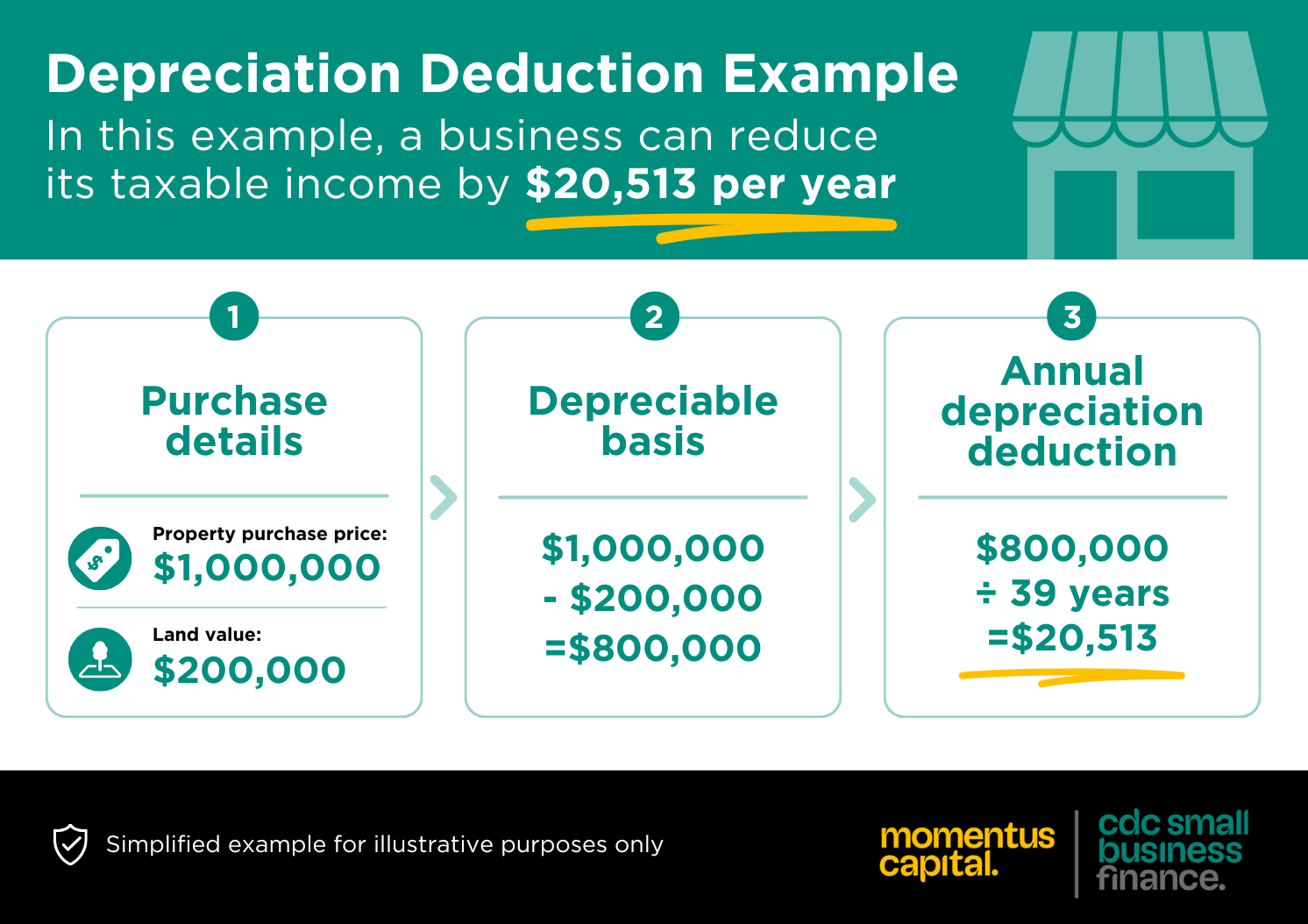
Business owners can write off a portion of the building’s value each year using the depreciation deduction. This tax break applies to the physical structures on the property, such as the buildings, but not to the land itself.
The IRS assigns a useful life of 39 years to commercial properties. So if the business uses the straight-line accounting method, it will deduct the building’s value in equal portions over that period of time. This can help lower the business’s tax liability.
Let’s look at an example of a $1 million property.
Interest Expense Tax Deductions
The interest on small business loans, including commercial real estate mortgages, is deductible in the tax year that it is paid. For example, if a loan payment costs $5,000 a month and $2,000 of that amount is interest, the business can write off $24,000 of interest expenses for the year.
However, the business can only claim the deduction on loan funds that are spent. If the owner keeps some of the loan funds in the bank, they can’t deduct the interest paid on the reserved portion.
Non-mortgage Expenses
In addition to mortgage interest, it’s possible to deduct the cost of ordinary and necessary expenses required to carry out business in the building. For building owners, these expenses may include property management fees, insurance, professional services, maintenance costs, materials, and more.
It’s even possible for an owner to deduct the costs of traveling to and from their rental property, such as food and hotel stays, or the costs of educational events, such as real estate seminars, if they’re business-related.
However, major projects, such as a complete roof replacement, must be treated as an improvement and depreciated as an expense. The same goes if the business is restoring the property or adapting it for a new use.

Qualified Business Income Deduction
The qualified business income tax deduction allows eligible small-business owners to exclude up to 20 percent of their business income on their taxes. It’s also possible to deduct up to 20 percent of qualified real estate investment trust (REIT) dividends and qualified publicly traded partnership (PTP) income.
This provides a tax break to business owners who invest in real estate by purchasing shares in a REIT instead of buying a building.
The deduction is designed for business owners with pass-through income, which is business income reported on a personal tax return. Sole proprietorships, partnerships, S corporations, and LLCs may all qualify for the deduction.
The income limit to qualify for the deduction is $383,900 for joint filers and $191,950 for all other returns. If eligible, the owner can claim the deduction through Dec. 31, 2026.
Capital Gains Tax Advantages
A capital gain occurs when a business sells commercial property for more than it paid to acquire it. The owner may owe taxes on that profit, which is the difference between the purchase price and sale price. The capital gains tax rate depends on how long the building was owned:
- Less than a year: Profit is taxed at the ordinary income tax rate, which can range from 10 percent to 37 percent depending on income level.
- More than a year: Profit is taxed at the capital gains rate, which ranges from 0 percent to 20 percent. The rate depends on income.
It’s possible to lower the capital gains tax in some cases. For instance, a business may reinvest proceeds from a property sale into a Qualified Opportunity Fund (QOF). Taxes would be deferred on the original gain until Dec. 31, 2026, or until the business sells the property (whichever comes first).
A QOF is an investment vehicle, usually structured as a corporation or partnership, that’s created to invest in economically distressed areas that are defined as Opportunity Zones.
To take advantage of the tax break, the business will need to reinvest its gains within 180 days of selling the property. If the business holds the investment for at least 10 years, any gains from the QOF can be excluded from taxable income altogether.
Considering buying a building for your business?
Connect with one of our SBA 504 loan experts about your financing options.
Transfer of Property to Heirs
If a business owner decides to bequeath commercial property, their heirs benefit from a tax advantage known as a “stepped-up basis.”
That means the property’s tax basis is adjusted to its fair market value at the time of the owner’s death, rather than the price originally paid for it.
As a result, if the heirs sell the property soon after inheriting it, they’ll owe little to no capital gains tax because the sale price will be close to the stepped-up basis value.
SBA 504 Loan: A Smart Way to Buy Commercial Real Estate
An SBA 504 loan is a type of financing designed to help business owners buy, build, or improve large assets, including commercial real estate. The terms range from 10 to 25 years with borrowing amounts up to $5.5 million.
The Small Business Administration (SBA) guarantees a portion of the loan, which allows lenders to offer financing at competitive rates with longer repayment terms and high borrowing limits.
Businesses can apply for one of these loans through a participating Certified Development Company, such as CDC Small Business Finance, part of the Momentus Capital family of organizations.
This loan program can finance up to 90% of the building’s purchase price, meaning borrowers will only need 10 percent of the total cost. However, for to be eligible for an SBA 504 loan program, the business should:
- Have a tangible net worth of $15 million or less
- Operate as a for-profit business within the United States or its possessions
- Have an average net profit after tax of less than $5 million
The Bottom Line
Buying a commercial building (or property) comes with a host of costs, but several tax benefits can help the business save money. Business owners can deduct depreciation, mortgage interest, routine expenses, and more. There are even tax advantages when they sell the property or leave the building to heirs.
If you need financing for your commercial property, an SBA 504 loan may be a good option. These loans provide up to $5.5 million with repayment terms between 10 and 25 years.
FAQ: The Tax Benefits of Commercial Real Estate
What are the tax benefits of buying a building for a business?
Buying a building for a business may include depreciation deductions on the building, deductions for eligible mortgage interest, deductions for real estate taxes on business property, and deductions for ordinary operating expenses tied to owning and using the property for the business. Routine repairs may also be deductible, while certain larger improvements are generally capitalized and recovered over time. Because tax treatment depends on how the property is used, how the deal is structured, and the owner’s broader tax picture, it is important to review the details with a qualified tax advisor.
Can you depreciate a commercial building used for a business?
⦁ Yes, a business can depreciate a commercial building, but not the land underneath it.
⦁ For federal tax purposes, nonresidential real property is generally depreciated over 39 years.
⦁ If you later make qualifying additions or improvements to the building, those may also be treated as separate depreciable property.
⦁ The exact treatment depends on the nature of the property and how it is placed in service.
Is mortgage interest on commercial real estate tax deductible?
Yes, mortgage interest on commercial real estate can be deductible if the debt is related to your business. The IRS looks at whether the loan proceeds are used for a business purpose and whether there is a real debtor-creditor relationship. However, the deduction may be limited in some cases under the business interest expense rules, so the amount you can deduct is not always unlimited. This complexity is one of the reasons it is helpful to review the financing structure with both your lender and your tax advisor.
Are repairs, maintenance, and building improvements all treated the same for tax purposes?
No. Routine repairs and maintenance are treated differently from capital improvements. Repairs and maintenance that do not improve the property may be deducted as current business expenses. By contrast, amounts paid for betterments, restorations, or work that adapts the property to a new or different use are usually treated as improvements, which means they are capitalized and recovered over time through depreciation rather than deducted all at once. The line between a repair and an improvement is not always obvious, which is why it is smart to document the work carefully and review significant projects with a tax professional.
How can an SBA 504 loan help when buying a building for your business?
- Lower down-payment requirements – only 10%
- Long repayment terms (25, 20 and 10 year options)
- Fixed rate for the term of the loan
- Projected income is considered, not just historical cash flows
- Collateral is typically the building being financed
Need assistance? CDC Small Business Finance has been helping small business owners get access to capital, including SBA 504 loans, for more than 40 years.
If you’re interested in applying, connect with one of our SBA 504 loan experts. Our team members can answer all your questions and help you submit an application.