


Key Messages
- SBA 504 fixed rates are most useful when evaluated as part of the project’s full financing structure.
- The fixed rate applies to the SBA/CDC-backed second mortgage, not automatically to the bank first mortgage.
- A typical 50/40/10 structure can preserve borrower cash for operations and planned capital needs.
- Current SBA 504 loan rates change monthly.
- CDC Small Business Finance should be involved before project cost, borrower injection, eligibility, or timing become constraints.
Have a borrower evaluating a building purchase, construction project, renovation, or major equipment financing? Talk with an SBA 504 loan expert before the borrower settles on a financing path.
For many SBA 504 commercial real estate borrowers, the rate question feels like the fastest route to a decision, but a building purchase may also include tenant improvements, environmental work, appraisals, closing costs, equipment needs, or a business plan that requires cash after closing. A lender must evaluate those details alongside the borrower’s operating performance, projected debt service coverage, and first-mortgage terms.
At CDC Small Business Finance, part of the Momentus Capital branded family of organizations, we help borrowers and lending partners review the entire structure, from project cost to borrower contribution and the difference between the bank first mortgage and the SBA-backed second mortgage.
How the 50/40/10 SBA 504 Structure Supports Commercial Real Estate Deals
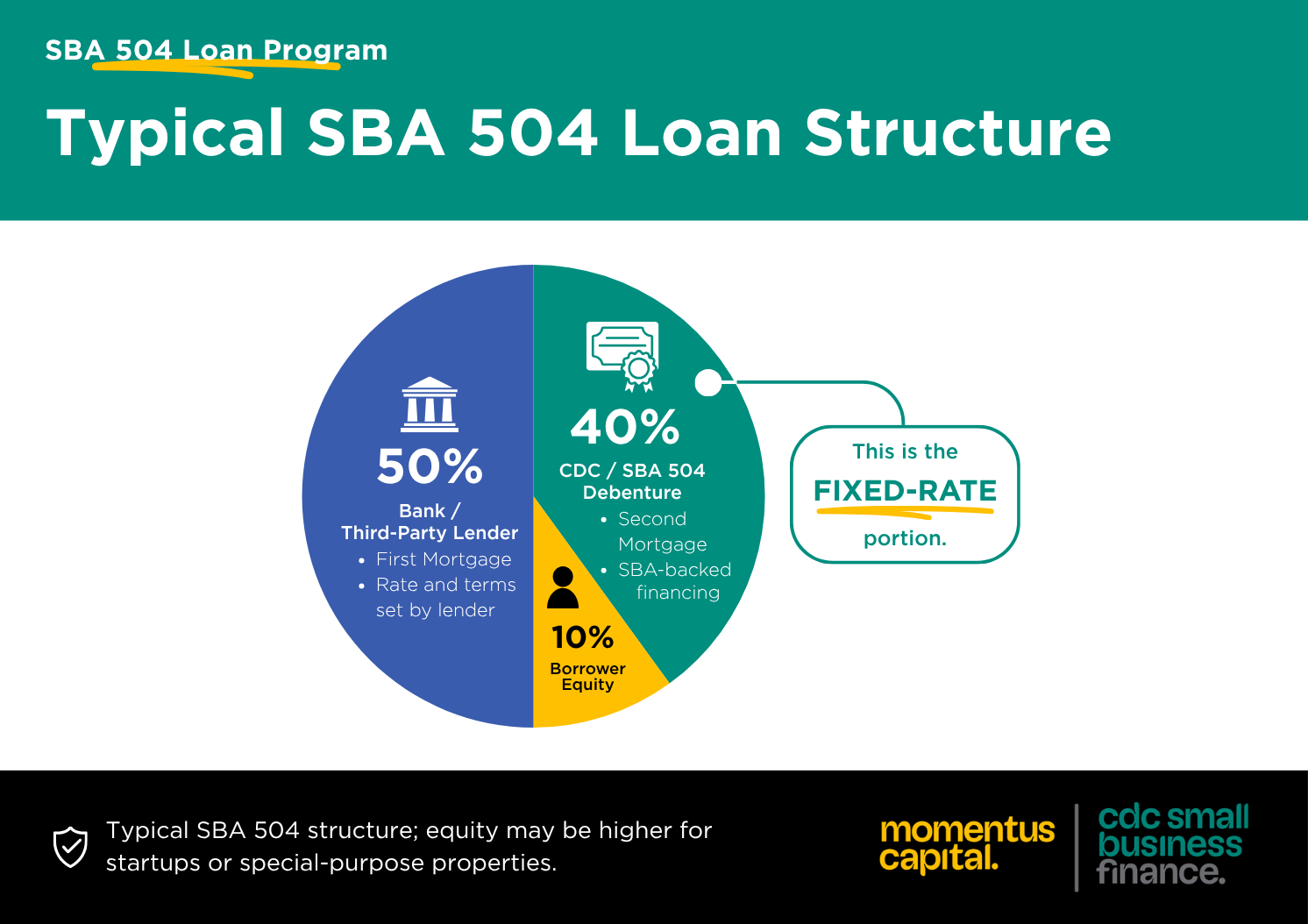
A typical SBA 504 structure includes:
- 50 percent: Bank (or other Lender) first mortgage
- 40 percent: SBA/CDC-backed second mortgage
- 10 percent: Borrower contribution
The SBA’s 504 loan program identifies major fixed assets, including buildings, land, facility improvements, and qualifying long-term machinery or equipment, as eligible uses of 504 financing.
The borrower contribution can be higher based on project specifics. Still, the typical split gives a lender a defined first-mortgage position while helping the borrower retain more cash than a conventional commercial real estate transaction may require.
What part of an SBA 504 loan has a fixed rate?
The fixed-rate feature applies to the SBA/CDC-backed second mortgage, commonly called the debenture. The bank provides the first mortgage and establishes its own rate, term, amortization, and underwriting requirements.
That distinction should be clear before anyone describes an SBA 504 loan rate as simply “fixed rate.” A borrower needs to understand the treatment of both loans, plus the borrower contribution, before comparing financing options.
To review the current rate, use the CDC Small Business Finance SBA 504 loan rates page. The figures change with monthly funding cycles, and the most current rate as well as a historical record of previous rates are listed here.
How SBA 504 Loan Rates Affect Payment Planning
A usable payment model looks beyond the SBA-backed rate.
| Input | Decision it Informs |
|---|---|
| Total project cost | How much financing the project needs |
| Borrower contribution | Cash retained for operations and future capital needs |
| Lender first mortgage | Separate rate, term, and amortization assumptions |
| SBA-backed second mortgage | Fixed-rate permanent financing component. |
| Estimated payment | Debt service coverage and occupancy cost analysis |
| Post-closing capital needs | Whether the project leaves enough operating flexibility |
A lender can use this structure to move the conversation from “Where are rates today?” to “Can the business support repayment of the full project?”
Review current SBA 504 loan rates, then contact a loan expert to model the lender loan, SBA-backed portion, borrower injection, and projected payment together.
How to Model an SBA 504 Payment
An SBA 504 payment estimate starts with more than an interest rate. Lenders and borrowers need to separate the lender first mortgage, the SBA/CDC-backed second mortgage, the borrower contribution, and eligible project costs.
The estimate should also account for the lender loan’s rate, term, and amortization; the current SBA 504 rate; projected monthly occupancy cost; and capital the business will need after closing. Those inputs help determine whether the proposed financing structure fits the project and the borrower’s repayment capacity.
Because final terms depend on underwriting, eligibility, documentation, and the timing of the debenture funding cycle, an early estimate should be treated as a planning exercise rather than a loan quote.
Why Fixed-Rate Financing Matters for Owner-Occupied Commercial Real Estate
A manufacturer buying a facility may need to retain cash for production equipment. A dental practice may want to compare projected ownership costs against a future lease renewal. A borrower planning construction needs to understand the permanent-financing structure before the project budget is final.
Banks face a similar question, “How can they support a strong client relationship without holding the full project exposure on their balance sheet?”
With a fixed-rate SBA-backed second mortgage, both the borrower and the lender can count on a steady payment structure, making it easier to estimate the long-term financing costs of the project. When it comes to project renovations, build-outs, or owner-occupied improvements, they should be reviewed early, keeping in mind the rules and processes needed for SBA 504 tenant improvements.
SBA 504 Loan Requirements That Matter for Fixed-Rate Commercial Real Estate Financing
SBA 504 generally serves eligible for-profit businesses financing owner-occupied commercial real estate or long-term equipment. A practical early conversation should cover:
- Business eligibility and repayment capacity
- Owner occupancy and project use
- Borrower contribution
- Eligible fixed assets and project costs
- Timing, especially when construction or improvements are involved
- Uses that do not fit the program, including working capital, inventory, speculative real estate, and ineligible debt
SBA 504 vs. 7(a): Which Works Better for Commercial Real Estate?
SBA 504 generally fits owner-occupied commercial real estate and major fixed assets. SBA 7(a) can be a better match when the project includes working capital, inventory, a business acquisition, or other uses outside the SBA 504 framework.
| Consideration | SBA 504 | SBA 7(a) |
|---|---|---|
| Primary fit | Owner-occupied real estate and major fixed assets | Broader business purposes |
| Rate treatment | SBA back portion is fixed | May be fixed or variable |
| Working capital | Not a standard eligible use unless refinancing existing owner-occupied commercial real estate debt. Working capital can be obtained through a refinance. | Separate rate, term, and amortization assumptions |
| Financing structure | Lender first mortgage + CDC/SBA portion + borrower contribution | Varies by lender and project |
Note: Our SBA 504 vs. 7(a) comparison page provides additional detail for lenders and borrowers weighing both programs.
When SBA 504 May Not Be the Right Fit
SBA 504 may not match a project focused on working capital, inventory, speculative real estate, a non-owner-occupied investment property, or a combined real estate and business-acquisition transaction.
Early review helps a lender and borrower compare SBA 7(a), conventional financing, or another option before a letter of intent, lease, or purchase agreement is signed and limits a borrower’s flexibility.
FAQ: SBA 504 Fixed Rates & Commercial Real Estate Financing
Are SBA 504 loans fixed rate?
The SBA/CDC-backed second mortgage carries a fixed rate. The bank’s first mortgage is negotiated separately and may have different pricing, repayment terms, and amortization.
What is the current SBA 504 loan rate?
SBA 504 rates change monthly with each funding cycle. Readers should use our current SBA 504 loan rates page and discuss project-specific assumptions with one of our SBA 504 loan experts.
What should lenders and borrowers review when estimating an SBA 504 payment?
A useful early estimate separates the lender first mortgage, the SBA/CDC-backed second mortgage, borrower contribution, project costs, and repayment terms. Current SBA 504 rates are only one input. The bank’s pricing, amortization, occupancy cost, and the borrower’s post-closing capital needs also fit into whether the project works or not.
What is the 50/40/10 SBA 504 structure?
A typical SBA 504 transaction includes a 50 percent lender first mortgage, 40 percent, fixed-rate SBA/CDC-backed second mortgage, and 10 percent borrower contribution. The contribution may be higher depending on project specifics.
What requirements should a lender review first?
Start with business eligibility, owner occupancy, repayment capacity, borrower contribution, eligible uses, and timing. Those items determine whether SBA 504 is worth structuring before a borrower commits to a property or project.
SBA 504 fixed-rate financing gives owner-occupied commercial real estate projects a defined long-term component within the permanent financing structure. The lender’s first mortgage, borrower contribution, projected payment, occupancy cost, and repayment capacity still determine whether the full project works. Reviewing those inputs together gives lenders and borrowers a clearer basis for deciding whether SBA 504 fits the transaction.
Let’s review the project structure, current rates, and eligibility.
This article is general information, not legal, tax, or financial advice. Borrowers should consult qualified advisers regarding those matters.