

Key Messages
- Small Business Administration (SBA) loans come with cost-saving features, such as competitive rates and waived upfront guaranty fees for qualified SBA Express borrowers, including service-disabled veterans.
- Service-disabled veterans can compete for dedicated federal contract dollars after pursuing SBA certification.
- Grants, or financial assistance that doesn’t have to be repaid, are sometimes designed for service-disabled veterans.
- Many veteran-focused loan programs connect service-disabled veteran borrowers to training, mentorship, and counseling.
Looking for the right financing for a veteran-owned business? From working capital to commercial real estate, CDC Small Business Finance offers loan options for eligible small businesses. Connect with our lending team to learn more.
Service-disabled veterans who want to start a business can access various programs and funding options. For instance, through the Small Business Administration and other partners, service-disabled veteran-owned small businesses can qualify for loans, grants, and specialized training that provide both capital and guidance. Here’s a look at the best programs and business loans for disabled veterans and how to apply.
Why Support for Service-Disabled Veteran Entrepreneurs Matters
While veterans own more than 1.6 million small businesses nationwide, many face unique challenges when getting started, from navigating service-related disabilities to securing startup capital and adapting military skills to the business world.
Finding support can help bridge the gap between a veteran’s military service and civilian success. That support may come through access to affordable lending and advising services from nonprofits. These resources empower veterans to build sustainable careers, strengthen local economies, and continue serving their communities through entrepreneurship.
Top Small Business Loans for Service-Disabled Veterans
Starting or growing a business often requires capital. Here are some veteran business loans service-disabled veterans can utilize.
1. SBA 7(a) Loans
The 7(a) loan is the SBA’s most popular program and provides funding up to $5 million for small businesses. Service-disabled veteran business owners can use loan funds for working capital, real estate purchases, business debt refinancing, and a wide range of other projects.
7(a) repayment terms depend on the use of proceeds.
| Use of Proceeds | Maximum Repayment Term* |
|---|---|
| Working Capital | Up to 10 years |
| Equipment | Up to 10 years (sometimes up to 15 years) |
| Real Estate | Up to 25 years |
*There can be specific exceptions. Reach out to our loan officers to see what’s available.
The SBA 7(a) Community Advantage loan offers loans from $30,000 to $350,000 for startups and existing businesses. Funds can be used for working capital, operating expenses, tenant improvements, equipment, business acquisitions, and refinancing business debt.
While 7(a) loans aren’t created specifically for veterans, many of the SBA’s policies benefit businesses that are veteran-owned.
For example, the SBA 7(a) Community Advantage program enables Community Advantage Small Business Lending Companies, such as CDC Small Business Finance, to help business owners with limited resources, including veterans, access credit more easily.
The Express loan, another type of 7(a) loan, waives the upfront fee for honorably discharged, service-disabled veterans and their spouses.
2. SBA 504 Loan
The SBA 504 loan program is designed to promote economic development. In addition to meeting the general loan criteria, a business must show it meets the SBA’s job creation or public policy goals.
Businesses can meet this requirement by creating or retaining at least one job for every $95,000 in SBA-backed debenture funding they borrow through a 504 loan, and qualifying small-manufacturer or energy-policy projects have a $150,000-per-job standard.
The 504 debenture borrowing limits go up to $5.5 million with terms of 10, 20, or 25 years. The funds can be used to purchase large assets, improve facilities and land, or pay off qualifying debt (typically debt originally used to purchase real estate or large assets like heavy machinery).
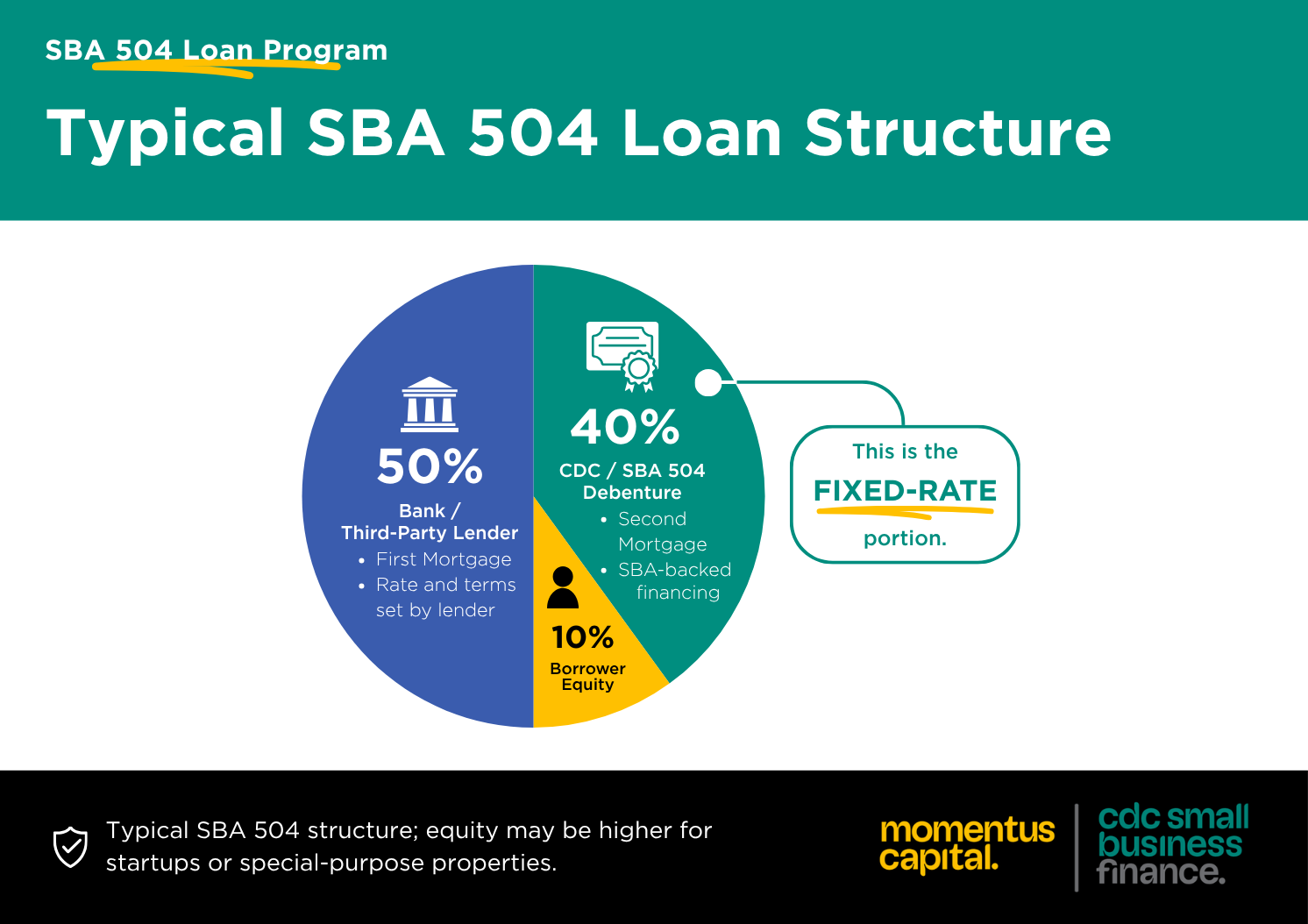
Service-disabled veteran business owners can apply for a 504 loan with a participating Certified Development Company (CDC), such as CDC Small Business Finance. A typical 504 project includes financing of 50 percent or more from a third-party lender, up to 40 percent from the SBA-backed CDC debenture, and at least 10 percent from the business. The minimum borrower contribution rises to 15 percent for new businesses or limited/special-purpose property and 20 percent when both apply.
3. Impower 95 Loan
Some businesses may not qualify for a 504 loan because of owner-occupancy requirements, citizenship requirements, or down payment concerns. In these cases, the Impower 95 loan, a special program offered by Momentus Direct Capital, an affiliate of CDC Small Business Finance, may help. The Impower 95 loan can be used to purchase commercial real estate with up to 95 percent financing and has no minimum credit score.
The streamlined process lets businesses get preapproved in as little as two weeks after submitting a completed application, and they may choose interest-only repayments to get started.
4. SBA Microloans
The Microloan is another SBA lending program. It’s often ideal for startups or businesses with smaller funding needs. Since many lenders have no down payment requirements, it can reduce a business’s upfront lending costs. Borrowing amounts top out at $50,000 with terms up to seven years.
SBA Microloans can be used for a variety of purposes that help small businesses expand, such as working capital, inventory, supplies, and machinery or equipment. However, proceeds from a microloan cannot be used to pay existing debts or to purchase real estate.
Service-disabled veteran business owners can apply for a Microloan through participating intermediaries, which are typically nonprofit community lenders like CDC Small Business Finance. Those intermediaries handle the application process and distribute the loans. They also typically provide education and other resources to borrowers. For example, our Business Advising Services offers free business advising to loan applicants.
5. Military Reservist Economic Injury Disaster Loan (MREIDL)
The Military Reservist Economic Injury Disaster Loan falls under the SBA’s disaster loan program. If a key staff member is a military reservist who is called to active duty, the MREIDL provides funding to help the business cover operating expenses. A service-disabled veteran could benefit from this program, for instance, if they employ a reservist who gets called to active duty.
Loan amounts can go up to $2 million, but the SBA determines each borrower’s limit based on the business’s actual economic injury. Repayment terms can be up to 30 years, and loans above $50,000 require collateral.
Businesses don’t need a lender to apply for an MREIDL. Instead, they’ll go through the SBA’s Disaster Assistance Portal.
Exploring small business financing?
CDC Small Business Finance helps eligible veteran entrepreneurs find financing options to start, purchase, or grow a business. Contact our team to discuss available loan options.