


Key Messages
- Commercial real estate has distinct terminology in every phase.
- This glossary will help business owners understand the key terms used throughout the buying process.
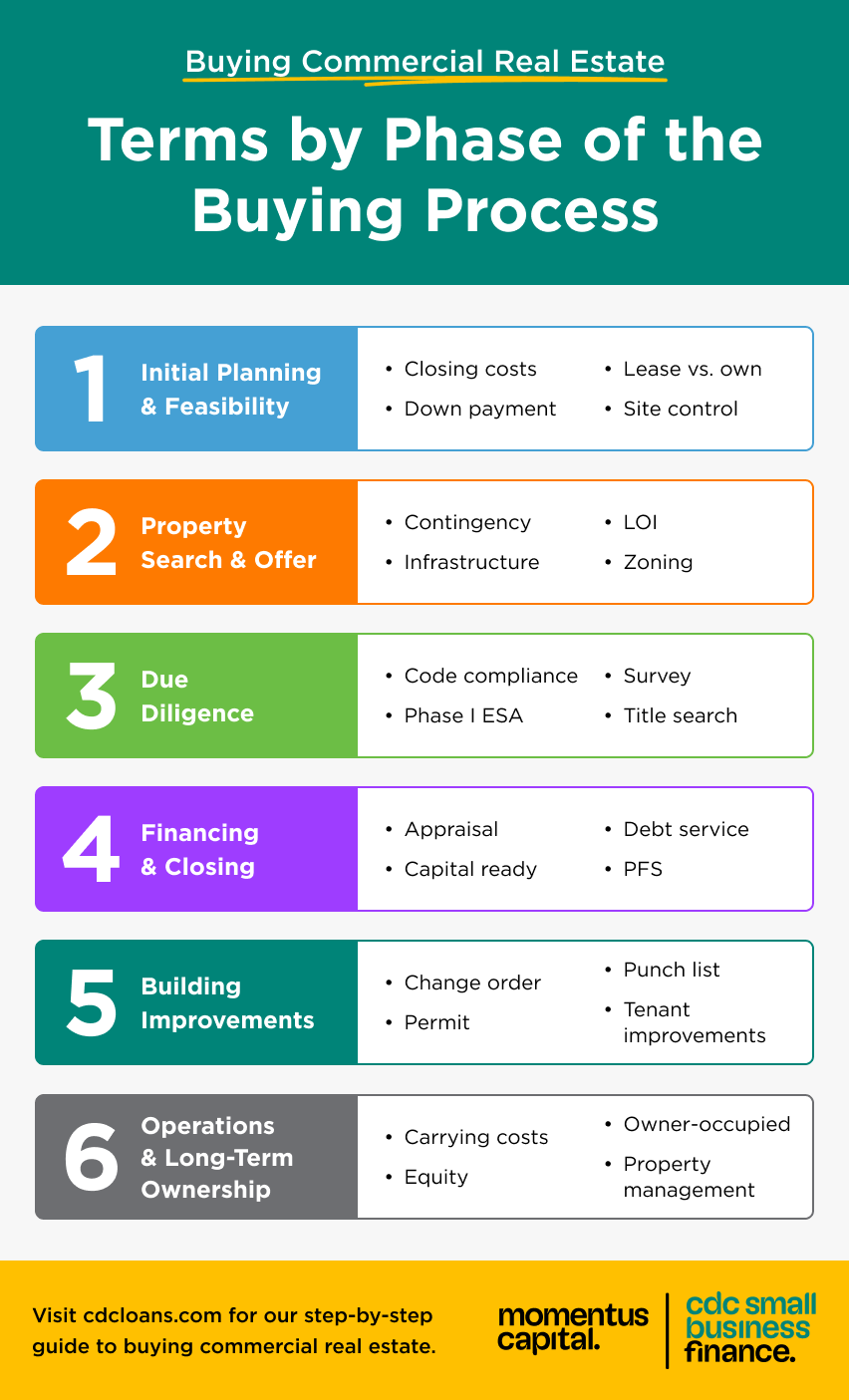
- Grouping terms by phase makes the definitions easier to use alongside our blog series.
Commercial real estate can feel more complicated when every conversation introduces new terms. CDC Small Business Finance’s commercial real estate glossary groups key terms by phase so small business owners can find definitions in the same order they are likely to encounter them.
Not sure which stage you are in? Contact us and a CDC Small Business Finance loan officer will help you map the next step.
Initial Planning & Feasibility
Acquisition: The process of identifying, negotiating, financing, and purchasing commercial property.
Lease vs. own cost comparison: A side-by-side look at the long-term cost of leasing compared with owning, including rent, loan payments, taxes, insurance, maintenance, repairs, and expected improvement costs. See lease vs. buy commercial property.
Down payment: The cash a borrower contributes toward the purchase price. Requirements depend on the loan product, property, and borrower.
Closing costs: Fees and expenses paid at closing, such as appraisal, title, attorney, loan, recording, environmental, and escrow costs.
Carrying costs: The ongoing cost of owning commercial property, including taxes, insurance, utilities, maintenance, and repairs. See cost of owning commercial property.
Development budget: A full project budget that includes purchase price, improvements, permits, soft costs, fees, contingency, and other expected costs.
Project timeline: A schedule showing major steps such as search, due diligence, financing, permits, construction, inspections, and move-in.
Organizational capacity: The business’s ability to manage the project, including staff time, decision-making, financial health, and experience.
Site control: Legal control of a property through a purchase agreement, lease, option, or deed.
Ready to Explore Financing?
Property Search & Offer
Zoning: Local rules that determine what uses are allowed on a property. See how to find commercial property for a business.
Infrastructure: Utilities and site systems such as power, water, sewer, gas, internet, drainage, and road access.
Use restrictions: Limits on how a property may be used, which may come from zoning, deeds, associations, or other rules.
Letter of Intent (LOI): A preliminary document that outlines major deal terms before final legal documents are completed.
Contingency: A condition that must be satisfied for the deal to move forward, such as financing, inspections, zoning, or permits.
Due Diligence
Due diligence: The structured review of a property before closing to confirm legal, physical, environmental, financial, and regulatory details. See the commercial real estate due diligence checklist.
Title search: A review of public records to confirm ownership and identify liens, claims, or restrictions.
Survey: A professional map showing property boundaries, structures, driveways, encroachments, and easements.
Easement: A legal right that allows another party to use part of the property for a specific purpose.
Phase I Environmental Site Assessment (ESA): An environmental review that looks for signs of possible contamination based on records, history, and site inspection.
Phase II ESA: Follow-up testing, such as soil or groundwater testing, when a Phase I identifies possible contamination concerns.
Property inspection: A physical review of the building and major systems, such as roof, HVAC, plumbing, electrical, and structure.
Code compliance: Whether the property meets applicable building, safety, accessibility, fire, and occupancy rules.
Innocent Landowner Defense: A legal protection that may help buyers avoid liability for contamination they did not cause, if proper environmental due diligence was completed.
Financing & Closing
Capital ready or loan ready: Prepared to apply for financing with a clear project plan, financial records, budget, timeline, and repayment story. See how to finance commercial real estate.
Pro forma: A financial projection showing expected income, expenses, debt payments, and performance.
Debt service: The loan payment obligation, including principal and interest.
Appraisal: An independent estimate of the property’s market value.
Personal Financial Statement (PFS): A document showing an owner’s personal assets, liabilities, and net worth.
Business debt schedule: A list of the business’s current loans, balances, monthly payments, interest rates, and maturity dates.
SBA 504 loan: An SBA-backed financing option for eligible owner-occupied commercial real estate and major fixed assets. Learn more about SBA 504 commercial real estate loans.
SBA 7(a) loan: An SBA-backed loan that may support a range of business uses, depending on eligibility and program terms.
Impower 95 loan: An alternative owner-occupied commercial real estate financing option when an SBA 504 loan or traditional bank financing is not a fit. Learn more about Impower 95.
Escrow: A neutral third party that manages funds, documents, and closing requirements.
Deed: The legal document that transfers ownership from seller to buyer.
Title insurance: Insurance that protects the buyer and lender against covered title problems discovered after closing.
Looking to finance the purchase of a commercial property? Contact us to learn more and get started.
Building Improvements
Tenant improvements: Renovations or upgrades that make a space work for the business, such as walls, plumbing, electrical, HVAC, fixtures, accessibility, or specialized build-out. See tenant improvements and build-out.
Build-out: The construction process that turns a space into a functional location for the business.
Soft costs: Non-construction project costs such as architecture, engineering, permits, legal fees, environmental review, and project management.
General contractor (GC): The contractor responsible for managing construction, subcontractors, schedule, safety, and completion.
Permit: Local government approval required before certain construction or renovation work can begin.
Change order: A formal change to the original construction scope, cost, or timeline.
Punch list: A list of final items that must be completed before the project is finished.
Contingency reserve: Money set aside to cover unexpected costs or scope changes.
Operations & Long-Term Ownership
Owner-occupied: A property where the business owner uses a required portion of the building for its own operations.
Equity: The owner’s value in the property after subtracting the outstanding loan balance.
Property management: Ongoing management of maintenance, vendors, repairs, tenants, and building operations.
ADA compliance: Meeting the accessibility requirements that apply to the property.
Fire and life safety: Building systems and rules that protect occupants during emergencies, such as alarms, exits, sprinklers, and extinguishers.
Occupancy permit: Local approval confirming that the space is safe and approved for the intended use.
Understanding these terms can make conversations with brokers, lenders, attorneys, contractors, and advisors clearer and more productive.
Need Help Applying These Terms to Your Project?
Follow the Phases in Our Guide to Buying Commercial Property
- How to Buy Commercial Property: A Step-by-Step Guide for Business Owners
- Phase 1: Lease vs. Buy Commercial Property: Should a Business Owner Buy?
- Phase 2: How to Find Commercial Property for a Business
- Phase 3: Commercial Real Estate Due Diligence Checklist for Buyers
- Phase 4: How to Finance Commercial Real Estate: Loan Options, Underwriting, & Closing
- Phase 5: Commercial Property Tenant Improvements: How to Plan a Build-Out
- Phase 6: Cost of Owning Commercial Property: Responsibilities & Long-Term Strategy
- Commercial Real Estate Glossary: Key Terms for Business Owners