


Key Messages
- Financing commercial real estate is a process with multiple steps.
- Being loan ready supports a smoother underwriting process.
- Different products fit different borrower and property situations.
- Many delays happen when documents or project details are incomplete.
Commercial real estate financing involves more than submitting an application. A lender needs to understand the borrower, the business, the property, the project budget, the timeline, and how the business will repay the loan.
For small business owners, the goal is to be organized before underwriting begins. A complete package helps the lender evaluate the project and reduces unnecessary back-and-forth.
Preparing to finance a property? Contact us to get started so financing can move in parallel with due diligence.
What It Means to Be Capital Ready or Loan Ready
Being capital ready or loan ready Capital Ready or Loan Ready Prepared to apply for financing with a clear project plan, financial records, budget, timeline, and repayment story. Open Glossary means the business can show a clear project plan, stable operations, financial records, repayment capacity, and realistic assumptions about cost and timing. This usually includes:
- A clear use of funds
- A defined property or project
- Current financial statements
- Tax returns
- A realistic project budget
- Internal capacity to manage the project
- Alignment among owners, partners, advisors, and lenders
If the project includes construction or tenant improvements, the improvement scope should also be clear.
Planning to Buy or Improve a Commercial Property?
The Commercial Real Estate Financing Process, Step-by-Step
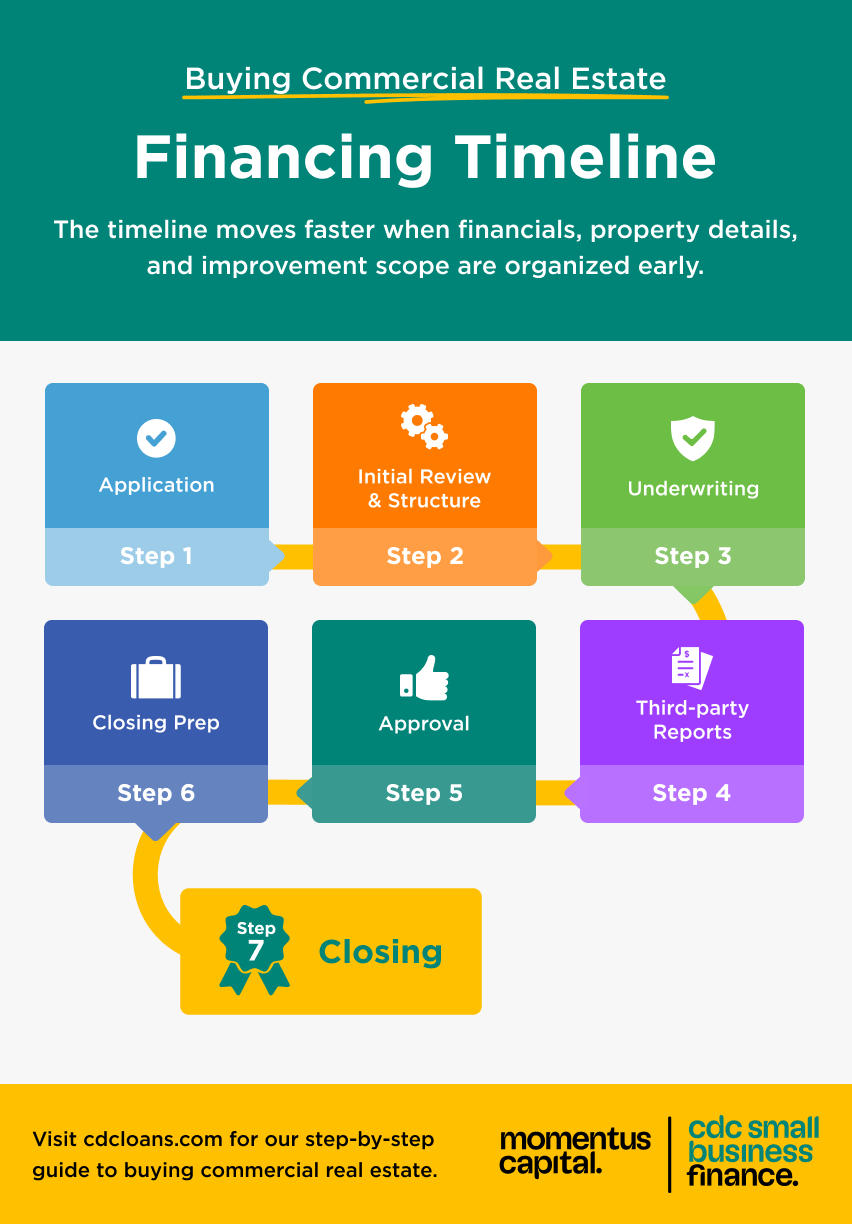
Most commercial real estate financing moves through a sequence:
- Application or pre-qualification
- Initial review and structure
- Underwriting
- Third-party reports, such as appraisal and environmental review
- Approval
- Closing preparation
- Closing
For SBA 504 transactions, the SBA 504 loan timeline can also include interim financing and debenture funding after the initial closing.
What Lenders Typically Require
Requirements vary by loan type and project, but business owners should be prepared to provide:
- Business and personal tax returns
- Credit information for business owners or guarantors
- Personal financial statement (PFS) Personal Financial Statement (PFS) A document showing an owner's personal assets, liabilities, and net worth. Open Glossary
- Year-to-date profit and loss statement and balance sheet
- Business debt schedule Business Debt Schedule A list of the business's current loans, balances, monthly payments, interest rates, and maturity dates. Open Glossary
- Business plan and projections, when needed
- Signed purchase agreement
- Appraisal Appraisal An independent estimate of the property's market value. Open Glossary
- Environmental and inspection reports
- Construction bid if improvements are included
Sharing incomplete or outdated documents is one of the most common sources of delay.
Financing Paths for Owner-Users
The right financing path for commercial real estate depends on the business, property, project size, occupancy, credit profile, and intended use.
SBA 504
An SBA 504 commercial real estate loan is designed for owner-occupied commercial real estate and major fixed assets, which are large physical items that a business buys to use for a long time, not to sell. It can be used to buy, build, or improve commercial property. SBA 504 financing is known for long-term, fixed-rate financing and a structure that often includes a lower borrower contribution than conventional financing. Business owners can also review the SBA 504 video guide for a short overview of eligibility, structure, and benefits.
SBA 7(a) Community Advantage
SBA 7(a) Community Advantage financing is generally suited to smaller loan amounts, often up to $350,000, which can make it a strong fit for lower-priced properties or projects within that range. It can support uses such as working capital, business expenses, equipment, inventory, tenant improvements, and certain real estate-related needs. For startup borrowers, documentation and equity injection planning matter, and the guide on SBA 7(a) loan down payment for startups explains how funds, project cost, and documentation are evaluated.
Impower 95
Impower 95 is an alternative loan product for owner-occupied commercial real estate when an SBA 504 loan or traditional bank financing is not a fit. It may provide higher loan-to-value financing and more flexible eligibility, depending on the borrower and property.
Not sure which financing path fits your business? Contact CDC Small Business Finance to walk through options.
What Happens in Underwriting
During underwriting, lenders review the business’s ability to repay, current and historical financial performance, credit, project cost, collateral, ownership structure, property use, and documentation. The lender may ask follow-up questions or request updated information. This is normal, and the more complete the file is at the start, the easier it is to respond.
What Happens at Closing
At closing, final documents are reviewed and signed. The borrower contributes the required funds, loan documents are executed, and title transfers. Depending on the financing structure, there may be additional steps after closing, especially for construction, tenant improvements, or SBA 504 debenture funding.
Common Financing Delays
Common delays include:
- Outdated financial statements
- Missing tax returns
- Late appraisal or environmental reports
- Unresolved due diligence findings
- Changes to purchase price, seller credits, or repair credits
- Unclear tenant improvement scope
- Missing contractor bids or permits
Financing moves more smoothly when the business is prepared, the documentation is complete, and the loan product fits the project. After financing is in place, many buyers turn to tenant improvements and build-out.
Ready to Move Forward?
Contact CDC Small Business Finance to discuss your options.
Follow the Phases in Our Guide to Buying Commercial Property
- How to Buy Commercial Property: A Step-by-Step Guide for Business Owners
- Phase 1: Lease vs. Buy Commercial Property: Should a Business Owner Buy?
- Phase 2: How to Find Commercial Property for a Business
- Phase 3: Commercial Real Estate Due Diligence Checklist for Buyers
- Phase 4: How to Finance Commercial Real Estate: Loan Options, Underwriting, & Closing
- Phase 5: Commercial Property Tenant Improvements: How to Plan a Build-Out
- Phase 6: Cost of Owning Commercial Property: Responsibilities & Long-Term Strategy
- Commercial Real Estate Glossary: Key Terms for Business Owners