


Key Messages
- Ownership can create stability, predictable occupancy costs, and equity.
- The lease-versus-buy decision should compare costs over several years.
- The upfront cost includes more than the down payment.
- Not every business is ready to buy commercial property at every stage.
- Financing options matter after a business confirms ownership is the right move.
For many small business owners, buying commercial property starts with a practical frustration: rent keeps rising, the space is hard to customize, or the landlord controls decisions that affect the business.
Buying commercial property can solve some of those problems. It can also add new responsibilities. Before starting a property search, the stronger first step is to weigh the lease vs. buy commercial property decision and confirm whether owning the building fits the business’s finances, operations, and long-term plans.
Thinking about buying a commercial real estate property? Contact us to inquire about whether commercial real estate ownership makes sense for your business.
Why Business Owners Consider Buying Commercial Property
Business owners often consider buying for four reasons:
- More control over the space
- More predictable long-term occupancy costs
- The ability to customize the property for the business
- The opportunity to build equity over time
For owner-occupied commercial real estate, one of our commercial real estate loans may support the purchase, construction, or improvement of commercial property. But the loan conversation should come after the ownership decision. The first question is whether or not buying commercial real estate supports the business.
Considering Buying a Building for Your Business?
What Owner-Occupied Commercial Property Means
Owner-occupied Owner-occupied A property where the business owner uses a required portion of the building for its own operations. Open Glossary commercial property means the business buying the property will use a meaningful portion of the space for its own operations.
This matters because many financing programs for commercial real estate are built around owner occupancy. If a business owner plans to lease out part of the building, they should discuss that plan with the lender early.
Lease vs. Buy Commercial Property: How to Run the Comparison
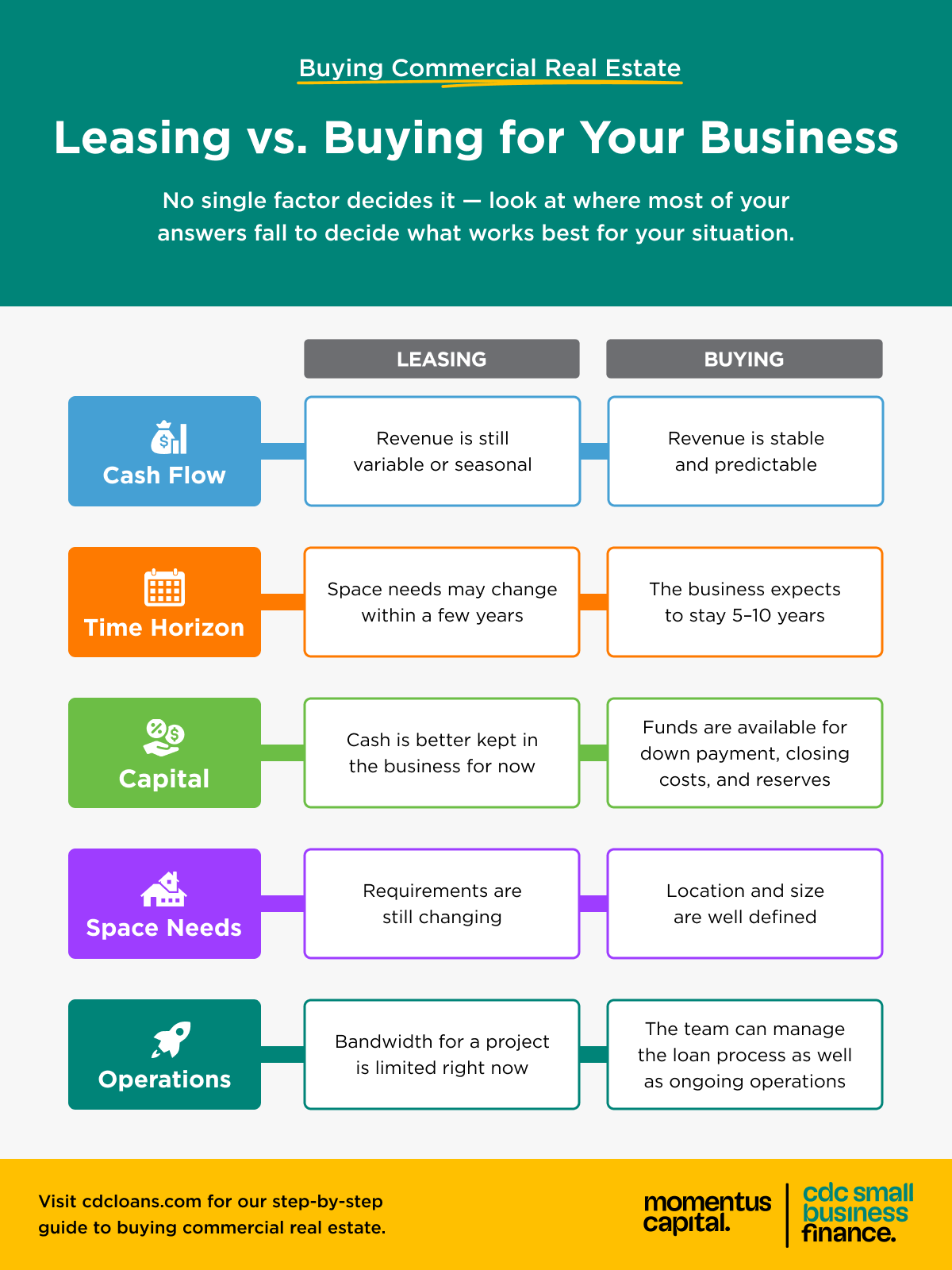
A lease-versus-buy comparison should look beyond the current monthly rent. It should model likely costs over the next 5 to 10 years.
On the lease side, include rent, rent increases, common area maintenance, triple-net charges, utilities, tenant/leasehold improvements, and relocation risk at renewal.
On the ownership side, include loan payments, property taxes, insurance, utilities, maintenance, repairs, closing costs, due diligence costs, and renovation needs. A business loan calculator can help estimate payments, but it should be only one part of the analysis.
The right answer is not always “buy.” Leasing may make sense if the business expects to move, grow quickly, shrink, or conserve cash for operations.
Want to understand your financing options or if ownership looks like the right fit? Contact us today.
What Upfront Costs Should a Business Owner Expect?
The down payment Down Payment The cash a borrower contributes toward the purchase price. Requirements depend on the loan product, property, and borrower. Open Glossary is only one part of the upfront cost of buying commercial property.
Business owners should also plan for closing costs, appraisals, environmental review, inspections, legal fees, title costs, permits, design costs, renovation costs, and working capital during the transition.
Some financing structures may allow certain soft costs or improvements to be included in the loan, but that depends on the product, borrower, property, and project.
How to Tell Whether Your Business is Ready to Buy Commercial Property
A business may be ready to buy when it has:
- A clear reason for ownership
- Stable operations and repayment ability
- Enough cash for upfront costs and reserves
- Confidence in location and space needs
- A realistic project timeline
- The internal capacity to manage brokers, lenders, attorneys, inspectors, and contractors
If most of these are in place, the business is usually ready to move from the decision stage into a property search.
Financing Paths That May Come into Play Later
CDC Small Business Finance is a mission-based lender that helps small business owners finance owner-occupied commercial real estate. Two paths come up most often for owner-users, and it helps to know them before the property search:
- An SBA 504 loan is long-term, fixed-rate financing for owner-occupied commercial real estate. It can be used to buy, build, or improve a property and is known for a lower borrower contribution than conventional financing.
- Impower 95 is an alternative for owner-occupied commercial real estate when an SBA 504 loan or traditional bank financing is not the right fit.
These are introduced here only so the terms are familiar. The financing conversation belongs after the business confirms that buying commercial property is the right move, not before.
Common Mistakes at the Decision Stage
The biggest mistake is starting the property search before confirming readiness. Other common mistakes include:
- Comparing mortgage payment to rent without including taxes, insurance, maintenance, and repairs
- Underestimating renovation and soft costs
- Using all available cash for the purchase and leaving too little working capital
- Assuming every property will qualify for the same financing path
- Forgetting that ownership adds code, maintenance, and property-management responsibilities
The lease-versus-buy decision belongs before the property search. When small business owners understand the numbers, timeline, and operational fit, the next step, how to find commercial property for a business, becomes clearer.
Ready to Pressure-test Your Decision?
Contact CDC Small Business Finance to get started.
Follow the Phases in Our Guide to Buying Commercial Property
- How to Buy Commercial Property: A Step-by-Step Guide for Business Owners
- Phase 1: Lease vs. Buy Commercial Property: Should a Business Owner Buy?
- Phase 2: How to Find Commercial Property for a Business
- Phase 3: Commercial Real Estate Due Diligence Checklist for Buyers
- Phase 4: How to Finance Commercial Real Estate: Loan Options, Underwriting, & Closing
- Phase 5: Commercial Property Tenant Improvements: How to Plan a Build-Out
- Phase 6: Cost of Owning Commercial Property: Responsibilities & Long-Term Strategy
- Commercial Real Estate Glossary: Key Terms for Business Owners